When a Spring Goes in Cold Weather in Colorado Springs
Why torsion springs snap in Colorado Springs winters, what your home's 1951-2006 build era means for the hardware, and when a cold-weather break can wait until morning.
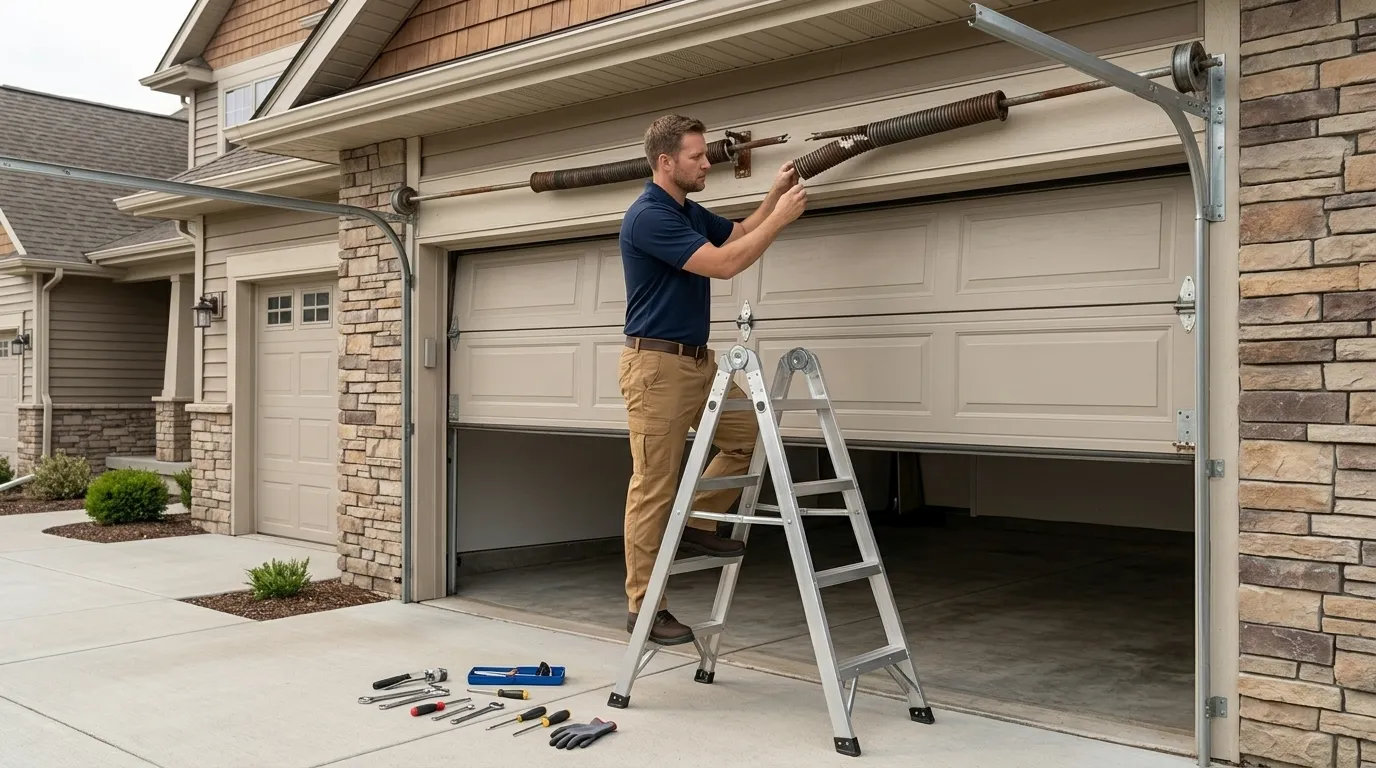
A torsion spring stores tension by twisting steel wire around a shaft above your door. Steel contracts when it gets cold, and the metal loses a little flex right when the spring is working its hardest to lift a heavy door. In a COLD-severe climate band like this one, that combination shows up as a loud bang in the garage on a sub-freezing morning, usually the first lift of the day when the spring is coldest and stiffest.
Most houses in this service area were built between 1951 and 2006, with the bulk of the stock going up through the 1980s and 90s across the fifteen named areas we cover, from Cimarron Hills and Stratmoor out to Monument and Woodland Park. A spring installed when a 1980s or 90s house was built has had three or four decades of freeze-thaw cycling on it. That's not a defect, it's just wear catching up with the cold at the same time.
When a spring breaks, the door goes heavy fast. If you're standing under it or trying to force the opener through a broken spring, you can bend the track or burn out the opener motor trying to muscle a 150-pound door on nothing but a chain drive.
When Waiting Is Fine
If the spring broke overnight and it's sitting at 10 degrees outside, you don't have to call anyone before sunrise. A broken spring means the door won't lift safely, not that anything is getting worse by the hour. Leave the door down, don't run the opener against a dead spring, and wait for daylight or a reasonable hour.
The one thing that does make waiting a bad idea is a second vehicle trapped inside a garage you need for the morning commute, or a door that's stuck half-open in the cold with the opening exposed to wind. Beyond that, a spring failure is a scheduling problem, not an emergency repair, in most cases.
We don't stock every spring size on the truck for every one of the older builds in this area - a torsion setup on a house built in the early 1950s can use hardware that's a special order, and that's worth knowing before you assume same-day is guaranteed for every job.
Checking It Yourself
Before you assume the spring, look at the shaft above the door. A broken torsion spring has a visible gap in the coil, usually a few inches wide, and the two halves will have sprung apart along the shaft. That's different from a cable off a drum or a bent track, both of which can also stop a door cold on a freezing morning.
Don't try to lift the door manually to test it once you see the gap. With the spring gone, the full weight of the door is on you and on the opener arm, and older doors from the 1980s and 90s stock common to this area are often heavier steel than what's sold today.
If the door was working fine yesterday and won't budge today, and the garage was noticeably colder than the house overnight, cold-related spring failure is the reasonable first guess before you start pulling apart the opener or checking the sensors.
What Local Conditions Do
The COLD-severe climate band this area sits in means the swing between a warm afternoon and an overnight low is wide and frequent through the winter months, and that swing is what fatigues a spring faster than steady cold would. It's the repeated contraction and relaxation, not just the temperature itself, that shortens the working life of an aging spring.
Houses built through the 1990s peak of this area's growth typically have standard torsion setups that hold up fine with normal maintenance, but a spring that was already near the end of its cycle count from summer heat and daily use is the one that goes on the first hard freeze. If your home falls on the older end of the 1951-2006 range, the spring may never have been replaced at all.
How it works
From “it’s stuck” to “it’s fixed”
01
Tell us what’s wrong
Describe the symptom - won’t open, loud bang, opener runs but the door won’t move.
02
On-site diagnosis
A technician tests the door under power and by hand and finds what actually failed.
03
Clear, up-front plan
You get the fix that’s needed and what drives the cost - before any work starts.
04
Repaired & tested
The repair is done, the door is set true and tested, and the work area left clean.
Serving Colorado Springs, CO - tell us what your door’s doing and we’ll take it from there.
Why did my spring break on the coldest morning of the year?
Cold steel is stiffer and less forgiving right as the spring works hardest lifting the door. In this area's COLD-severe climate, the daily swing between afternoon warmth and overnight lows adds fatigue cycles a spring in a milder climate wouldn't see, so failures cluster on the sharpest cold snaps.
Is a broken spring dangerous to leave overnight?
Not by itself. Leave the door down, don't force the opener, and wait for a normal service hour unless you need the garage for a trapped vehicle or the opening is exposed to wind. The risk is trying to lift the door manually, not the wait itself.
Do older homes in this area have different spring hardware?
Some do. Housing here runs from 1951 through 2006, and a house from the early end of that range can have a torsion setup that isn't a stocked size, which sometimes means a special order rather than a same-day swap.
Can I just replace the spring myself?
We don't recommend it. A torsion spring is under enough tension to cause serious injury if it lets go while you're winding it, and matching wire size and wind direction to the original setup matters more than it looks like it would.
Ready to get your garage door sorted?
Tell us what it’s doing and where you are in Colorado Springs - we’ll take it from there.